All LED lights for repairing
- Bike Light
- Bulb – AC
- charging Bulb – AC
- Flood light
- Panel light
- Spot Light
- Street light
- Tubelight
Finding wattage of SMD LED
Here is the Video explaining how to find the wattage of SMD LED
Video Summary –
- Four types of SMD leds rated 1v, 3v, 9v and 12v
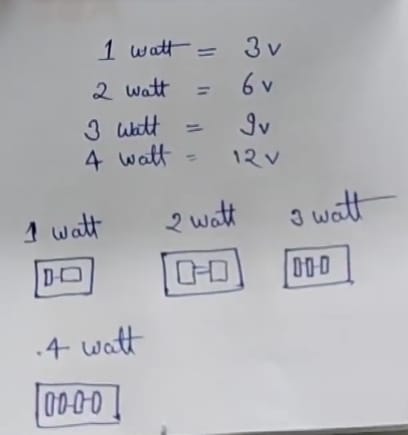
- In 1 watt SMD led there is two Lines – one big and one small as shown in figure above and require 3v dc to operate.
- In 2 wall SMD led there is two equal lines as shown in figure above and require 6v dc to operate.
- In 3 wall SMD led there is three equal lines as shown in figure above and require 9v dc to operate.
- n 4 wall SMD led there is four equal lines as shown in figure above and require 12v dc to operate.
LED Bulb Problems and their possible solutions
LED Bulb Flickering
LED bulb flickering can be caused by several reasons. The first reason may be that one of the LEDs in the SMD is faulty or burned out. If this is the case, you can either replace the LED or use an equivalent resistor in its place. Here is a video explaining four ways to do that:
Additionally, here is a video on how to identify the appropriate resistor you can use in place of the burned or faulty SMD LED:
No power in LED SMD
<feed info>
Low glowing and flickering LED
Video summary
- First check the smd LED. If the SMD LED is ok then check the output voltage. If the voltage is Low there is problem with IC or Capacitor.
- Faulty IC may also result in Low Glow which is due to low voltage output in range of 10 to 70 volts.
- Faulty SMD LED may also result in Low Glow.
SMD LED failure due to any reason
OK now you have a doubt that the smd led is faulty. now you should check each led by applying appropriate voltage accoriding to the wattage of the Led. the correct smd led will glow and faulty will not glow. just replace the faulty LED with good one according to their wattage.
Components of LED Bulb and their uses
NA
MCPC and Driver compatibility
Always use the same mcpc and driver for best performance.
Playlist of Youtube for LED Repairing
Finding the Ampere consumed by MCPC from driver
LED bulb driver correct voltage range
The correct voltage output range of an LED driver typically falls between 90 and 120 volts DC.
Repairing items for LED bulbs repair
-
B 22 cap
-
Driver (LED Bulb)
-
5W
-
9W
-
15W
-
18W
-
-
Driver (LED Charging Bulb)
-
Driver (LED Flood Light)
- 30-40 W
-
Driver (LED Panel Light)
- 63 V driver (Maxitech Led driver)
-
Driver (LED Spot Light)
- 72 – 130 V driver (Electron LED Panel light driver)
-
Driver universa
-
LED Strip
-
MCPC (Flood Light)
-
50 w
-
100 w
-
120 w
-
150 w
-
200 w
-
-
MCPC (LED Bulb)
-
5W (5w/10w/15w/20w/25w) = normal driver mcpc and dob mcpc
-
9W (9w/18w/27w/36w/45w) = normal driver mcpc and dob mcpc
-
15W (15w/30w/45w) = normal driver mcpc and dob mcpc
-
18W (18w/36w/54w) = normal driver mcpc and dob mcpc
-
-
MCPC (LED Charging Bulb)
- NA
-
MCPC (Spot Light)
-
Find wattage
-
Types of DOB

Alpha vs Gamma DOB
Alpha vs. Gamma in LED DOB Technology:
- Alpha DOB:
- Definition: Alpha DOB is an early version of Driver on Board (DOB) technology for LEDs. It generally integrates basic driver components onto the same board as the LED chips. It may not include advanced features such as improved power factor correction (PFC) or reduced flicker.
- Efficiency & Flicker: Alpha DOB typically lacks high-end flicker control and power efficiency features, which can result in flicker issues and lower efficiency.
- Complexity: This approach is simpler and may be more cost-effective but may not meet the standards for all applications, especially where high-quality lighting and efficiency are important.
- Gamma DOB:
- Definition: Gamma DOB represents a more advanced version of the Driver on Board technology, incorporating enhanced driver components directly on the LED board. Gamma DOB includes improvements such as high power factor correction and reduced flicker, making it a more sophisticated version compared to Alpha DOB.
- Efficiency & Flicker Control: Gamma DOB technology aims to address issues such as flicker reduction, better voltage regulation, and improved energy efficiency, resulting in a more reliable and stable lighting solution.
- Complexity: Gamma DOB is more complex and may be more expensive, but it provides higher performance and quality, making it suitable for professional or premium applications.
Summary:
- Alpha DOB: Simpler, cost-effective, but potentially less efficient with issues like flickering and lower power factor.
- Gamma DOB: More advanced, offering better flicker control, higher efficiency, and improved performance, but potentially higher in cost and complexity.
Both technologies aim to integrate the driver and LED components, but Gamma DOB represents a higher standard in terms of quality and performance.